Pages

Showing posts with label DC Receiver 40m. Show all posts

Saturday, 23 November 2019

40m Direct Conversion Receiver - modification for low signal levels

Pleasing to see the level of interest this project has generated. There has been an on-air problem which does not show up in bench testing and the explanation and correction for that follows.

Issue:
The AGC does not compensate for very weak signals. This is only noticed in very low noise  environments and requires manual adjustment of the volume control to hear these weak signals.

Explanation:
The generation of the negative rail for the audio stages is injecting ripple onto the plus and minus 12V rails. This ripple is inaudible but the decoupling is not sufficient to prevents the AGC from believing it is a valid audio level. Weak received signals reaching the AGC which are lower than the ripple are not benefiting from the AGC increasing the audio gain to compensate.

The issue was overlooked on the bench when weak signal testing because the volume control had been manually adjusted.

Correction:
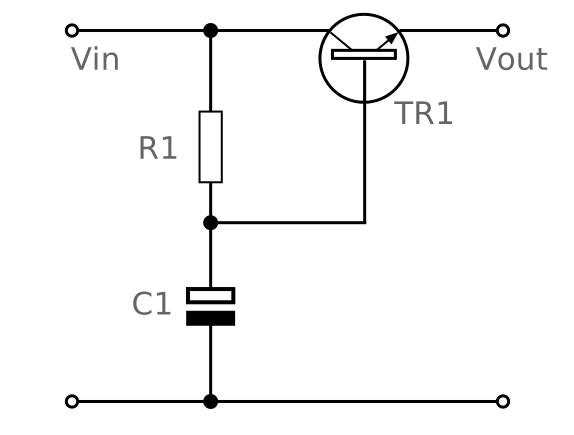
The decoupling of the 12volt rails by the 68ohm and 22uF capacitor is insufficient. To reduce the voltage drop that would occur if R was increased a capacitor multiplier using a transistor is used. The 68 ohm resistor is changed to several k and this RC connection is made to the base of a transistor.


See sites like  https://www.electronics-notes.com/articles/analogue_circuits/transistor/capacitance-multiplier-circuit.php for an explanation of how this works.
Basic transistor capacitance multiplier circuit
Note that a npn transistor is used for the plus 12v rail and a pnp transistor for the negative 12v rail.
http://electronics-diy.com/electronic_schematic.php?id=486 shows how the emitter and collector connections are reversed for the pnp transistor on the negative rail.

Outcome:
The AGC action now includes very weak signals.

Sunday, 4 March 2018

40m Direct Conversion Receiver - Completed

Update: Also read this for fixing AGC for weak signals

It doesn't matter how good something appears on the test bench, it's the on-air baptism that counts. This weekend there was an ARRL contest. A proper baptism of fire. So imagine the smile when I turned the receiver on with a dipole connected. Wall to wall signals. North American stations, JA's, VK's.  They were all there. Strong, loud and clear.

This morning, Sunday, I listened to the local new broadcast on 40m. I could hear every station that checked in. And I could just cope with the strong signal of Chris VK6JI who runs the broadcast and call-backs. Chris's station is perhaps 5km away so it is a full scale signal on every radio I have. I hope to simultaneously  record the call backs one day, my homebrew receiver on one channel, my IC746pro on the other. I know there will be a difference, but not much.

Now that I have the bugs of this approach sorted out I'm using one of the commercial boards for an 80m version.

There is one thing that I learned from this version: how a voltage inverter can cause trouble. I used an ICL7662 to create a negative rail for the op amps.  What I failed to catch until I tested the unit was the ripple from the ICL7662 was large enough in amplitude to upset the squelch circuit. That was my fault for not bypassing the V+/2 rail the squelch used. One capacitor and problem solved.

Now all of my design goals have been met.

  • lots of volume from a speaker since headphones don't work if you're moving about the workshop while you listen to a net,
    • Passed - I can easily listen to a net while moving around my very large workshop.
  • no audio instability, 
    • Passed. Micro-phonics solved by using tantalum's instead of MLCC's in certain parts of the circuit.
  • no hum, 
    • Passed.
  • good AGC so you are not jockeying the volume control, 
    • Passed
  • good audio filtering
    • Passed
  • a squelch. 
    • Passed.
That's 6 from 6. I'll finish the 80m version soon but it's time to focus on updating the synthesiser and transmitter to accompany this receiver. Then I'll have a working homebrew 40m transceiver again.

Complete schematics except for the squelch. I'm happy to pass on details of the squelch circuit privately. But as far as I know it is copied from a Codan radio so I'm mindful of copyright.

Regards
Richard VK6TT

Sunday, 25 February 2018

40m Direct Conversion Receiver - Testing successful

Today I finished assembly and correction of a few minor mistakes of the receiver. The end product performs really well on the bench. In summary:
  • about 80dB of dynamic range
  • no instability whatsoever, even at "crazy" loud volumes
  • no microphonics
I'm looking forward to on-air testing this week.

Regards
Richard VK6TT

Thursday, 20 October 2016

40m Direct Conversion Receiver - Final modifications and comments

I made a few more modifications to my receiver and the end result was outstanding!

Firstly, I found the audio AGC prone to distortion on strong signals. The first syllable of every word was a flat spot on the oscilloscope trace till the AGC reduced the gain. The fix was more than a larger capacitor. I found the attack time was too short for voice signals.

The fix was a comparator which independently of the NE570 charged up the rectifier capacitor thereby reducing the gain of the NE570 much faster. See the modified AGC schematic below:
Modified AGC circuit


The final issue was the weak signals seemed to be down in the noise now. Since I had hacked the initial audio stages to use a differential pre-amp, I reasoned I needed a bit more gain. Since I still had an op-amp on the circuit board I simply configured a x10 stage and put it before the low pass filter. Next time I would eliminate the trim pot shown and simply use a 47k resistor. SMR3 might need to be lowered if you don't get enough gain. Since I find putting another 1206 resistor on top of an existing one straightforward I'd build it with a 10k resistor then adjust if necessary SMR3 by putting say a 6k8 resistor on the top if more audio gain is needed.

Modified low level audio stages


So let's see how well the goals for this project were met:

  • lots of volume from a speaker since headphones don't work if you're moving about the workshop while you listen to a net,
    • Passed - I can easily listen to a net while moving around workshop.
  • no audio instability, 
    • Partial pass. Micro-phonics mean the speaker has to be mounted separately to the radio. Otherwise, a pass.
  • no hum, 
    • Passed.
  • good AGC so you are not jockeying the volume control, 
    • Passed
  • good audio filtering
    • Passed
  • a squelch. 
    • Passed.
While I haven't spoken about the squelch circuit I sue that is deliberate on my part.  It was, I believe, a copy of a circuit used in Codan HF transceivers. It works superbly. On voice signals almost on the noise floor it opens and closes between words. I don't suffer any distortion or ill-effects. I'm happy to share this part of the circuit with you via email. Who knows what litigation might result if I simply posted it here?

My intention was to be able to hear S5 to S9+30 signals. I believe I can hear S3 or lower to S9+40 signals but I haven't done any back to back tests with a commercial HF transceiver. Maybe a stereo recording might be worthwhile?

So apart from the micro-phonics I'm absolutely stoked at how well this receiver works. I might build another for 80m at a later date!

73's
Richard

Wednesday, 5 October 2016

Differential Pre-amp for DC Receivers

I modified my receiver to use a differential audio pre-amp like the Juma does. My initial thoughts are this represents an improvement over the audio pre-amp stages I was using. I used a NE5532 because the calculations I did suggested it would be 10dB better than a TL072 and 13dB better than a LF353.

If I had a better OpAmp to hand I would have used it though my results suggest this would be unnecessary. My calculations showed the NE5532 was more than adequate and if purchased new represented real value. I was fortunate to have recovered almost 100 NE5532's from a few circuit boards I had lying around. So my cost was ham appropriate.

My subjective testing showed this modified receiver was good enough to reveal previously unknown deficiencies in my HP signal generator. I was getting a high pitched tone from the signal generator though this did not prevent me from copying stations on a DX net with ease. However, when I switched to the DDS board I used in my existing 40m transceiver the high pitched tone disappeared and stations from the other side of the world were armchair copy. And I feel this configuration, despite the lash up approach I used, was even more stable at high volumes.

I rate this as a worthwhile improvement. I'm not sure why it appears better than the previous discrete transistor audio preamp I was using. Part of the explanation I put down to the unknown pedigree of the recovered SMD transistors I was using.

Anyway, here are the modified schematics and I heartily recommend this approach to you.

Regards
Richard VK6TT
Audio pre-amp and Low Pass filter

Band pass filter and Product Detector

Friday, 23 September 2016

Direct Conversion Receivers - I Just Can't Leave This Alone!

Well, like a lot of things I do the 40m DC receiver I have been discussing never quite made it into a case. Despite ticking all the boxes on performance, I just have this uneasy feeling I am missing something. I listened to the audio in a you-tube video demonstrating an alternative design, the juma-RX1. The differences are minimal:
  • 2 pole BPF v 3 pole
  • different implementation of AGC
  • 1W v 5W audio stage
But something is nagging me. Perhaps the reason there are so few signals around when I get a chance to fire up the receiver is that Perth, where I live, is the most remote capital city in the world. It means just about every signal is "DX" distant for me. I looked really hard to the Juma schematic and they way audio is being recovered from the differential outputs of the product detector has me intrigued. I plan to hack my board around to allow a similar differential audio pre-amp stage to be used.

One of the nagging doubts is a carry-over from when I looked at RF transmitting transistors. Just because a part is labelled as a BC549 doesn't mean it is a "low noise" version. Since I don't know the origins of the NPN transistor I used in the audio pre-amp it is possible I am not getting the best performance possible.

In addition, tying the two mixer outputs together as I have done does not have the same intuitive appeal as the differential approach used by the Juma.

So my intent is to modify my receiver to use a similar differential audio pre-amp stage. I'll keep you informed of what happens.

73's
Richard VK6TT


Tuesday, 16 August 2016

Direct Conversion Receiver - Closing Comments (almost)

I've used this receiver for a while now and in the most part I'm very happy. There are some oddities that a worth mentioning.

No Local Oscillator connected or insufficient level

Without a local oscillator connected or insufficient drive the hex inverter oscillates at around 40MHz. At the same time the receiver audio is very noisy which I find odd. As soon as the local oscillator drive is connected, or increases, the noise suddenly stops when the self oscillation stops. The cause of this has me stumped but in practice it is of no concern.

Dynamic Range

I previously mentioned this and suggested I would use a trimpot to set the audio levels. I made this modification and found it went a long way to easing the adjustment of the audio gain to avoid clipping on strong signals.

However, this did not prove to be the complete panacea for clipping. The problem with setting the gain of the audio chain so you can cope with really strong local signals is you relegate weak signals into the receiver noise.I have concluded this is in due to the way the NE570 operates. I am going to tweak this and report back soon.

In the meantime I hope you find something to build!

Regards
Richard VK6TT


Update: I think I've solved the dynamic range issue. It did turn out that hte strong signal I was trying to listen to was QRO strong. No wonder the NE570 was clipping. I inserted a 36k resistor, though anything from 33k to 47k would probably work, into the signal path connecting to pin 6 on the NE570. See the image below.


This allowed the NE570 to cope with this huge QRO signal yet still have enough gain when needed to amplify weak signals.

Direct Conversion Receivers - Remaining challenges

Well I've just about wrapped up talking about this subject. But before you go away thinking everything is covered there are two challenges that you need to be aware of - Dynamic Range and Microphonics.

Dynamic Range

My agc circuit uses a NE570 and has a dynamic range of 60dB. Which I use to cover signals between approximately S5 and S9+30. Signals stronger than S9+30 will distort without some attenuation. And when there are no signals, or low noise levels, the audio gain is running very high. This  creates the potential for instability and is why I spend so long investigating this area. In the end I tailored SMR9 (the 150k feedback resistor shown below) to suit. I ended up with 100k here and pleasing audio resulted for all stations heard. If I was building this again I would make SMR12 a variable 50k trimpot to ease adjustment to cope with the typical stations being received.

Microphonics

This is a recent problem for me. My previous versions were built in a modular form and I never noticed any microphonics, But the sensitivity of my current version is in part due to a low level of noise in the audio circuits. I also built the entire receiver on one board. Both of these factors have contributed to  microphonics becoming apparent.

After replacing all the surface mount ceramic caps in the low level audio stages with tantalums I still had microphonics. It appears these are originating from a 1206 resistor biasing the base of the transistor in the first audio stage. (refer Figure below) I came to this conclusion after watching the output prior to the agc circuit on the cro. Tapping the board anywhere produced a noticeable voltage spike. But slight pressure on this resistor resulted in a 10 or more fold increase in the spike when the board was tapped. Surrounding parts did not react this way.
Figure 1: Highlighted Microphonic Resistor

I have replaced the resistor but there has been no resolution. Looking at the circuit, above, makes this even more curious. Presumably, the microphonic voltage is being injected into the base and appears at the collector. However, I would expect the 10uF tantalum capacitor to bypass any microphonic noise appearing at the base to ground. My thoughts going forward to fix this are:
  1. replace the 10uF tantalum,
  2. put another capacitor on the emitter of Q2 in case the noise is being injected into the audio signal path through SMR13,
  3. mount the resistor on edge, or
  4. use a through hole part (defeat!).
I will let you know what worked.

Regards
Richard VK6TT

Footnote: turns out tantalum was bad. I pulled out my ESR meter and it hardly moved the needle. Replacing it cured the microphonics from this resistor. However, with that sorted I found the sensitivity was dreadful. Which sounds odd. After an hour or so of working back through the audio chain towards the mixer it turned out that the 330nF from the two 100 ohm resistors to ground was noisy. Now this is something I had never come across before but must have been due to leakage current from the 2.5V DC across this capacitor. But from before and after tests this capacitor was defintely the culprit so it was binned and another used. Problem solved.

Replacing all the high capitance surface mount ceramics with tantalums and through hole parts certainly created some headaches but all is good now. In the first 20 minutes of tuning across 40m I logged SSB stations from the east coast of Australia, New Zealand and Indonesia here in Perth on the West coast of Australia.

Tuesday, 9 August 2016

Direct Conversion Receiver - Band pass filter and mixer schematics

Here then is the circuit diagram for the band pass filter and mixer, or product detector. I stress that this receiver was never meant to be a simplistic incarnation, nor was it intended to be complicated. Each iteration was an attempt to improve performance with the least possible effort but sometimes this required more components.

Band Pass Filter and Mixer

Please take note of the comments on the schematic if you decide to make your own circuit board. If you want a commercially made board I may still have some left that reflect these comments.

I tried three trifilar transformers. The first was wound on a really small ferrite bead but I suspect it lacked inductance to work effectively. The second was wound on a larger bead, one that fitted over the top of miniature coax. It worked but I had some intermittent problems with it which I suspect was the result of the enamel insulation being damaged. So I wound a third on a miniature binocular ferrite and it worked a treat. My point is be prepared to try a few variations till you find something that works for you.


Regards
Richard VK6TT

Saturday, 30 July 2016

Direct conversion receivers - Curing Audio Instability

You might be forgiven for thinking that after sorting out a bandpass filter and mixer that the hard part is over. Unfortunately, this is the part where art is just as important as science. The two largest issues to address are instability and selectivity.

Instability arises from two causes: feedback via the positive supply rail and feedback via the negative supply rail. The positive supply rail is readily fixed with RC decoupling and voltage regulation. The negative supply feedback is prevented with grounding and layout. Let's look at each audio stage and see what was done.

Audio Amp:

Since I'm running several watts of audio output we have to watch feedback carefully. The circuit board puts several capacitors close to the audio amplifier chip. But that is only the start and active regulation is used elsewhere to reduce feedback via the positive supply rail. Now the subtlety of layout takes over. The power is connected close to the audio amplifier chip. Just like a "star ground", the remainder of the receiver draws power from the far end of the track on which the capacitors sit. Don't think of the track as being 13.8 volts. Instead, consider it as high current. We want to power the remainder of the receiver from a point that has the lowest current. The point I use still has to be decoupled further and I run the rest of the receiver from a low drop out regulator of 12 volts.

The same concept applies to the negative rail. Current in the negative rail is what gives rise to a voltage differential between the point the negative supply connects to the PCB, or local ground, and any other point connected to the local ground via a trace. To minimise the current flowing between local ground and anything other than the audio amplifier ground, I break the ground into two major sections.

The first is just around the audio chip and power connector on the bottom sides of the PCB. The attach image tries to explain this. The green tracks are ground on the bottom layer. The only parts sharing this ground plane are the audio amp, the supply capacitors and the power connection. The top ground plane only connect to this green layer via the power supply pin. This prevents any circulating current from flowing through the ground plane on the top side of the board.

Ground Traces for Audio Amp


With a grounding scheme that hopefully minimises feedback on the negative rail we can look at the other audio stages.

Audio Pre-amp:

The first audio stage uses a discrete bipolar amplifier. In practice I never found an op amp in my junk box to be as quiet as this circuit which I first saw in the August 1992 edition of QST in an article by Rick Campbell. My implementation is a bit casual in comparison. I simply used what I had to hand that was close to Rick's circuit. I have found the active decoupling circuit on the positive rail sufficient when taken from the regulated 12 volt line.Before I used a regulated 12 volts I had instability problems, but that could have been also partly due to layout.

Audio Low Pass Filter:

The output of the audio pre-amp drives a low noise op-amp for further gain before an 8 pole low pass filter. I have used both switch capacitor filters and active filters based on op-amps. I don't have a strong preference either way. Both approaches work really well but I have stuck with the op amp approach this time.

In the past I used a rail splitter to bias the op amps. The drawback is any noise or feedback on the positive and negative rails finds itself at the input connected to the rail splitter. It will be attenuated, but is still present. This time I  took the regulated 12 volts and inverted it to negative 12 volts.  I was hoping for a magic bullet but I'm not sure if this extra complexity made much difference. But since the receiver is working I'll follow the wise saying "If it ain't broke, don't fix it!"

Other Grounding Issues:

One issue I had when building this receiver took some time to understand. When completed it was not as sensitive as I expected. The clue to fixing this arose when I disconnected the local oscillator and the loudspeaker noise increased. This occurred even when I removed the inductor between the audio pre-amp and the product detector.

With the oscilloscope probe grounded at the negative power supply pin I poked around and found the 74HC04 squarer I was using was generating lot's of hash with no local oscillator input. Forcing the input pin low with a screwdriver blade eliminated the noise and hash. As the circuit to be posted later showed there was heavy decoupling on the power supply to this part. Holding a tantalum capacitor across the existing decoupling capacitors next to this IC made no difference. Looking at the circuit board revealed the cause:


As current flowed from the ground pin of the IC it was in part flowing past the grounding points of the pre-amp (Shown with * in the diagram above). Since current flowing through a finite resistance gives rise to a voltage this was injecting noise into the pre-amp via the grounded components. The fix was a via to the top layer at the ground pin and for good measure a via at each group of decoupling capacitors on the positive supply to this part. (Shown with # in the diagram above). The result was an increase of sensitivity of around 15dB!

Summary

Curing audio instability and feedback is a dark art. I am only just starting to get my head around this issue so any useful advice is really appreciated. One thing I have learned is that connecting the ground lead of your cro to the negative supply rail of your power supply where it connects to the pcb then poking around is very illuminating.


Regards
Richard VK6TT

Monday, 25 July 2016

Direct Conversion Receivers - RF Bandpass Filters

Today I'm turning my attention to the RF bandpass filter used between the aerial and the product detector. If you see a circuit that just uses a single tuned circuit for filtering then move on. Really. The maths and software for working out values has existed for so long that there is no excuse for single tuned circuits.

So let's move on to considering double versus triple tuned circuits. It's very easy to use filter software like Elsie, AADE or Iowa Hills. My favourite is the Iowa Hills software. It does 80% of what I want with the least effort so I always start with this software.However, I'll step you through how I made an error and suffered from a deaf receiver till I worked it out.

This first part was done in Elsie but it was not the fault of the software. Rather, it was a case of garbage in, garbage out. Here is a double band pass filter for 40m. Since it is a 300KHz segment we will use that as the bandwidth.
I like it, but perhaps a triple band pass filter will look better?
I'm getting excited. Let's compare the two responses on the same graph to see what we trade-off for the extra selectivity:
Okay, we give up 2dB of loss in the passband for much better selectivity. Sounds good to me. Or is it? At this point I was pulling my hair out with a deaf receiver. How did that happen? Quite apart from using by mistake the wrong value parts when I built the filter, it transpires that the curves above were designed around inductors with an unloaded Q (Qu) of 200. What happens when we use a more realistic Qu of 70 for the inductors? We suffer an extra 5dB of loss in the case of the triple band pass filter with this bandwidth.
Which gives us almost 8dB of loss before the product detector. In urban areas that may not be an issue if you have high noise levels. But in my location 8dB sounds excessive given the low noise levels I enjoy. And this extra loss compounded a problem I had which we will discuss in another post concerning low noise op amps.

I learned my lesson. Check your assumptions before you build. In practice I start with a bandwidth of 10% of the centre frequency, say 715KHz in the case of 40m. I then adjust the bandwidth and terminating impedances until I get some standard capacitor values.

You can iterate away a lot of time if you're not careful. My favourite package, the Iowa Hills Filter Designer package, is well suited to this task. After just a few clicks I get the following circuit and response:
Which all looks really nice. But no loss? That doesn't make sense. Remember to check the real parts box! The resulting loss is 1.5dB. That was so easy I repeat the exercise for a triple bandpass filter. I get a loss of approximately 2.1dB. At the third harmonic of the local oscillator, or 21MHz, the 2 pole filter has an attenuation of 15dB. In contrast, the 3 pole filter has an attenuation of 42dB. I don't want to be hearing stations on 21MHz when I'm tuning around on 7MHz. Given the improved selectivity of the triple band pass filter over the double, I elected to go with the triple despite the slightly higher loss. Finally, I tweak the design by broadening the response while watching the loss at 7MHz and 21Mhz. I end up with less loss than the 2 pole filter but better attenuation at 21MHz.

All of which took me less time to do than write! Here are the two filters compared:


Which is all fine so far. We have standard capacitor values. Inductors are always harder to source. If your junkbox has variable inductors of a nominal 600nH then you're in business. The Q of these is likely to be around 70. Coilcraft make a really nice series of 10mm vairable inductors which would be ideal and with Qu in the mid 70's match what I assumed in the software. (Coilcraft, if you're reading this I'd love some of your stuff but it's so damn expensive in Australia that I can't afford it!)

So off to the junkbox. What? No 600nH inductors.

Lots of recovered variable inductors around 3uH though. Back into the software. Hmnnn. 3uH is too large a value for the shunt LC tank to work. I try the series option just in case. Viola! I get a practical design with losses comparable to the version discussed above and a suggested 90dB of attenuation at 21MHz. I really doubt I can achieve that in practice without serious shielding but it should go a long way towards attenuating signals on harmonics of the local oscillator. Of course, there is no free lunch here. I have less attenuation of signals below 40m now. Of concern is a nearby 50KW AM broadcast signal on 720kHz breaking through but to date I haven't noticed any such problems.
Final 3 Pole 40m Bandpass Filter - Series versus Parallel configuration


I found the triple bandpass filter easy to peak using a signal generator on 7150kHz and a local oscillator or 7149kHz. I tuned for maximum audio after the audio low pass filter, the subject of the next post.

I hope you're inspired to download the Iowa Hills software and start rummaging through your junkbox for variable inductors.

73's
Richard VK6TT


Monday, 18 July 2016

Direct Conversion Receivers - Simplistic designs do not do them justice

I was pulling apart some goodies that I recently acquired to see what was inside and found myself looking at switched capacitor filters, NE570 compander chips and low noise op amps. It took me back to when I was actively building HF transceivers consisting of Double Sideband Transmitters and Direct Conversion (DC) receivers and the long path to success. I found the final result well worthwhile so I thought it was worth updating my receiver onto one PCB and posting about what I learnt.

Firstly, I'm going to be controversial and point out that the majority of DC receiver projects usually found on the web are not serious receivers. I don't mean they aren't enjoyable, rewarding or capable of hearing signals. They can do all of that. But they are just cheap. Thrown together with a minimum of parts as if saving a few pennies becomes a virtue allowing you to overlook the shortcomings.

Nope. I've been at the cheap end and it is very unsatisfying. My design criteria are:
  • lots of volume from a speaker since headphones don't work if you're moving about the workshop while you listen to a net,
  • no audio instability, 
  • no hum, 
  • good AGC so you are not jockeying the volume control, 
  • good audio filtering, and 
  • a squelch. 
In short, I want a DC receiver that can be used without having to apologise for it's failings.

I was able to achieve these goals and build a 40m DSB transmitter / DC receiver combination that I actually used in a contest. This is not suggesting it was competition grade. Rather, it was a radio which worked well enough that it had to be punished to uncover shortcomings. And while it struggled at times with a band of strong contest signals I considered the results acceptable.There were many, many, iterations over more than a decade before I deemed the results acceptable.

Over three or four posts I will take you through the final configuration that achieved this stage be stage. I will discuss what I tried, the shortfalls and the improvements (or corrections!) I made before I was satisfied.

Today we will start with the product detector, or mixer. This is perhaps the single most important design decision that shapes everything else. In chronological order I've tried the following product detectors:
  1. Discrete transistor product detector
  2. LM1496
  3. SBL-1 diode mixers and equivalents
  4. FST3125 mixers
What I found was they all worked, but some are better than others. The discrete transistor mixer, used as a product detector, actually worked surprisingly well. I couldn't find a LM1496 back then, or a CA3028 or similar. So I lashed one together from discrete transistors (BC109's from memory) as if it was a CA3028. It was so long ago I couldn't find my notes but it was similar to this one: Discrete transistor Mixer

Eventually I found a LM1496 and that  looked more conventional, see below. The output of the product detector was feeding a low pass filter built around a LM324. As I discovered later the LM324 was too noisy. But since I didn't know any better I was running the LM1496 at maximum gain by connecting a capacitor between pins 2 and 3. I could hear stations and I made several contacts with the transceiver this was used in, but I still suffered from cross modulation and strong signals overloading it.

Lesson Learnt: With no RF preamp you need a low noise audio stage after the product detector even when using an active mixer.

LM1496 Product Detector


So I moved on to a diode double balanced mixer, the SBL1. The holy grail I thought. A triple band pass filter to reduce the chance of cross modulation and overloading from transmitters outside the 40m band.

SBL Product Detector (Note: Filter values shown proved to be wrong!)
But I still had a deaf receiver. About this time my collection of test equipment had grown to include a HP signal generator and an oscilloscope. Now I could make repeatable measurements i.e. a measurement made today would be the same as a measurement made 2 weeks prior. Poking and prodding revealed the RF bandpass filter had too much loss and the audio strip was still too noisy.


The temporary fix was to install a RF preamp between the band pass filter and the mixer. This transformed the radio. Ultimately I sorted out the loss in the RF bandpass filter, fitted a low noise audio amp directly after the mixer and was able to remove the RF preamp.

And while this served as the product detector for a good year or more I still wasn't happy. I live in a low noise location so connecting the aerial did not always produce a large increase in noise in the loudspeaker. So I built a product detector around a FST3125. With my now further improved collection of test gear I could see that this approach had promise. Importantly, this IC is far cheaper and more readily available than the SBL1. It can often be found on early server motherboards for free.

While I was satisfied with the SBL1 style mixer, I consider the FST3125 product detector to be at least as good and far cheaper. Next time I will discuss the RF bandpass filter..

More on that later.
73's
Richard