Pages

Showing posts with label Parallel Transistors. Show all posts

Sunday, 7 May 2023

10W Class AB with parallel transistors - Follow-up to Initial SOT223 Package Results

Eventually I found time to measure the input impedance of the amplifier. With 3 turns on the input transformer the input impedance measured 340 ohms on 80m. This is the right most curve of the three shown below - the labeling of the markers might cause confusion. With 2 turns it dropped to 159 ohms and with just a single turn it was 37 ohms. 

Input impedance to 10W "JBOT" Amplifier


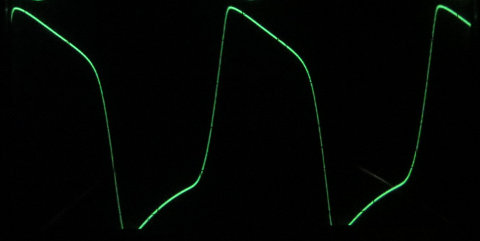
Gain for the 10W JBOT stage has risen to 20dB with the 1 turn winding. However, I'm not completely satisfied with the "shark fin" distortion that is present on the output. Perhaps I am too picky since I have never previously looked at the output of an amplifier before any low pass filtering. 

Next steps:

Add a low pass filter and measure the level of the harmonics.

If the harmonics are acceptable then I will have met my goal of a robust 10W amplifier.


Thursday, 16 March 2023

10W Class AB with parallel transistors - Initial SOT223 Package Results Encouraging

 Another trip to the races. 

The first SOT223 transistor I tried vindicated the switch to this package by being very robust. However, the gain was low and there was lots of distortion. 

The second SOT223 transistor I tried was very robust with over 10dB of gain. I left it running at 10W for several minutes with no ill effects. And I pushed it to 20W without blowing anything. An encouraging development. 

Now, if the gain was 10dB then the 1W driver amplifier board should not have a lot of distortion. However, it was distorted making me suspect the input to the 10W amplifier was not close to 50 ohms. While the results would only be ballpark and more of a pass/fail measurement I went to measure the input impedance to the 10W amplifier board with my nanoVNA. 

Unfortunately the shed PC was dead with what appears to be a power supply fault. Most annoying. Now I know where the magic smoke I smelled a few days ago when i powered up the shed equipment came from.

It is a distraction but I think I will buy a refurbished desktop PC to replace the now defunct XP machine. It was my programming workhorse but I have learned over the last couple of years that I can get all my software running on Windows 10. So rather than persevere with it now seems a good time to switch.

I will progress this as time permits and given the milder autumn weather now I'm looking forward to tackling this soon.


Saturday, 18 February 2023

10W Class AB with parallel transistors - Not yet, but 5W is OK

It appears a cheap, stable and effective 5W HF amp can be realised with parallel SOT89's and thermal bridges. 
 
A variety of transistors have been tested. Some could deliver 10W continuously for extended periods thanks to the thermal bridges and heatsink. However, none appeared capable of delivering 10W with low distortion.
 
Gain and power handling varied between transistor types. Some test boards could deliver well over 10W into the dummy load with no mishap. Harmonic distortion was present so a good low pass filter is essential. No issues with thermal runaway were noted.
 
I learned the hard way that a 1206 resistor had an insufficient power rating as an emitter ballast resistor when testing for extended periods. After replacing several sets of resistors I switched to a larger SMD resistor.

Having destroyed many sets of SOT-89 transistors I have concluded the SOT-89 package is not going to deliver 10W of RF continuously.  Using 10 parallel transistors the per package dissipation is around 2W (1W of Rf requires at least 2W of electrical energy). At times I saw 5 Amps of total collector current on the "guess" meter fitted to the power supply which was just too much for many of the devices. 

While several transistor types could deliver 5W with low distortion that wasn't my goal. So it's time to move on to a SOT223 package.


73's


Thursday, 19 January 2023

10W Class AB with parallel transistors - Qualified Success

I began some detailed measurements. In particular, I was interested at where the onset of distortion began. 

I started collecting data to build a chart on output power v input power. When I started measuring at higher output levels I found the buffer amplifier was in fact distorting above 1W of input power. Not surprising given it was designed to deliver 1W but something I hadn't considered till now.

But this means the first transistor I started measuring is probably not going to be the best transistor given the gain is lower than I wanted.


I call this a qualified success because I have a very robust and stable amplifier that delivers 10W, albeit distorted, and a maximum observed output of 14W with US$0.50 worth of transistors is outstanding.

At 5W it probably ticks all the boxes.

When time permits I'll test the second board I already have populated with a different transistor.

73's

Monday, 16 January 2023

10W Class AB - Almost a Success, then the Smoke Escapes

I tried the first alternative transistor and saw mixed results. The distortion on peaks was still present. I slipped with the attenuator control and pushed the amp to 20W. Briefly. Then all the emitter resistors let go. 

The distortion has me puzzled and is the same as the first amplifier with 10 parallel transistors. So I Googled and saw this waveform:
 
tube_drive_tone_control_maxed_out_480px 


The term "sharkfin" describes it well. The distortion in my amplifiers can be similar when pushed hard which does point to harmonics being present. The amount of distortion at 10W appears to depend on transistor type from results to date.
 

It appears I'm close to achieving 10W of output with 10 parallel SOT89 transistors. I'll replace the resistors and give it another try. A post with more detailed test results in due course.

Thursday, 12 January 2023

10W Class AB with parallel transistors - Take 2 preparations

Time for another attempt. A selection of SOT89 transistors was purchased allowing each board to be populated with 10 transistors of the same type.


One of two boards ready for through hole parts and smoke testing. It is sitting on the heatsink to check the hole alignment and the heatsink has been milled for clearance as necessary.


Monday, 21 November 2022

10W Class AB with parallel transistors - Almost

Update: I've learned that the cause of my waveform distortion (sharkfin) is most likely the presence of harmonics.

Time for a second attempt. The board was mounted to a CPU heatsink, milled for clearance underneath as necessary. Cautiously I increased the drive. I found I could easily achieve over 10W from 2 - 20MHZ. The distortion on peaks is evident so further work is needed. 

By testing with a single tone I am being harsh on the amplifier.  A two-tone test signal delivering 10 Wpep would have 2.5W in each tone. At 4W with a single tone there is no obvious distortion. I must drag my two tone generator out of retirement.

However, this JBOT approach with parallel SOT89's has merit. The distortion reminds me of what I saw with the 1W class A experiments when the biasing wasn't quite right. Even with 80mA of standing current in each transistor the distortion at 10W was present.

It appears a cheap, stable and effective 10W HF amp can be realised with parallel SOT89's. The application of a two tone test signal is needed before this particular transistor model is condemned.

73's


Thursday, 10 November 2022

10W Class AB with Parallel transistors - Initial Success

Having drafted a board with parallel SOT89's I sent the files off to have it fabricated.Upon receipt of the boards I found many errors and it transpires I generated the gerbers from an early draft which had not been finished. 

Out came the tools to manually fix the board and I populated the first board as a proof of concept. I ran out of 1210 resistors which I have been using as thermal bridges so I finished the board with 1206 resistors instead.

In my last blog I stated:

Since 2 of these in parallel class A could easily deliver 1W continuously it is reasonable to expect that 10 of them, operated class AB in push-pull, could deliver 10W. 

On reflection it would be reasonable to assume 10 devices could deliver at least 5W. I quickly found I could achieve over 10W but with some distortion. I also quickly found the smoke can escape.

Here is the board mounted on standoff above a heatsink which has a 50Ω resistor mounted to it. All of the emitter ballast resistors had burnt out. 

Presumably one transistor got too hot, developed a collector to emitter short which burnt out one resistor. Now 9 transistors were carrying the load, another transistor failed and resistor burnt out. Now 8 transistors.....Apologies to anyone with "10 in the bed and the little one said, roll over, roll over" now running through their head.

I will have to modify a second board and try again.


73's

Richard

Thursday, 22 September 2022

10W Class AB - Next Steps

So I checked, and re-checked, every transistor I could lay my hands on. Nothing was suitable for 10W. Nor does it appear anything can be purchased that might be suitable that has not been tried.

Several transistors in plastic encased TO220's worked fine at a few watts but couldn't cope beyond that.

From here I have stopped looking for a general purpose transistor for a single-ended  amplifier.

A board is being layed out with parallel SOT89's. Since 2 of these in parallel class A could easily deliver 1W continuously it is reasonable to expect that 10 of them, operated class AB in push-pull, could deliver 10W. 

Something to be put to the test in the near future.

73's

Richard


Wednesday, 8 June 2022

1 Watt RF Amplifier using General Purpose Transistors - Latest Iteration

Taking on-board the test results to date the latest iteration of the 1 watt amplifier has the following characteristics:

  • 1 Watt output
  • 2SC3356 > 2SD1664 > 2x 2SD1664R in Parallel
  • First two stages use a bifilar transformer to present the collector with 200 ohms for increased gain.
  • Use of resistors to provide a thermal bridge to ground for heatsinking. 

The results of my experiments have overturned my previous position. You do not need a working RF transistor, suitably rated, recovered from another radio to build 1 watt Class A HF amplifiers. 1W HF amplifiers can be reliably made using many of the general purpose transistors available that cost a few cents each.

If there is sufficient interest I'll put together a kit. My back of the envelope estimate is the cost would work out around US$5 for a PCB with all surface mount parts fitted.

Save those working RF transistors for more demanding applications!

73's

Richard

Thursday, 26 May 2022

Using 1210 Resistors as Thermal Bridges in 1W Transmitter

I mentioned in this post the concept of using surface mount resistors as thermal bridges. I've had a chance to explore this now and after various tests I'm completely satisfied this is a suitable way to heat-sink SOT-89 surface mount transistors in 1W HF amplifiers.

Balancing cost versus ease of installation  I settled on 4 pieces of 1MΩ 1210 resistors for each transistor. A 1MΩ resistor needs no further modification to isolate the collector voltage from ground. On an extended test the two parallel transistors had a  case temperature of around 130 degrees while dissipating a total of 3.4W and delivering 1W of RF to the dummy load.


I hope you find this tip useful.

73's

Richard

ps Please excuse the soldering. I'm using up some solder I would not recommend and and it's difficult to get a good joint without using too much.  That's compounded by it being too thick. 

My preferred solder is presently this one

My preferred flux is presently this one which I apply with a nylon type small paintbrush trimmed short to make the bristles a bit stiffer.

Friday, 20 May 2022

G.P. Transistors in RF Amplifiers - Parallel Ouput Transistors- Still More Success!

Seems I can't help myself but try different transistors. In the course of testing my resistor as a thermal bridge concept I needed to populate a test board for measurements. After that I finished populating the board and tested numerous transistors with it. 

Initially I had some problems, both a soldering fault and poor biasing due to an error in my spreadsheet. But I learned a lot about debugging this amplifier in the process. I have now tested a large assortment of transistors, both SMD and through hole. Most worked very well at 40m and 80m, some well beyond that. And I never encountered any instabilities.

Even on my narrow board I never let the smoke out of any transistor despite relentlessly abusing them. The only casualty was a 2.2ohm decoupling resistor burning out.

1 watt is about the limit with a 13.8 volt supply. The output signal is 20Vpp. After decoupling and loss in the collector choke you have about 13.2V at the collector. You need a bit over 1V on the emitter to set the current with a 5Ω emitter resistor. So you are left with a margin of say 2V to deal with saturation considerations. Even with everything going well the best you might achieve is an extra 1dB of output. Probably not worth the grief chasing it.

Too much standing current and the 2V margin is reduced. Too little standing current and distortion is present. What I do is calculate the bias component values based on a standing current of say 220mA since the bare minimum needed is 200mA for 1W of output into 50Ω. The base resistor to ground is then rounded up to a convenient value. Once built, check the emitter voltage. If higher than desired put a suitable value resistor in parallel with the base resistor to ground to reduce the emitter voltage to the desired value.

I then examine the emitter voltage (Ve) with my CRO. It must be greater than zero at all times when delivering the required 1W for a Class A amplifier. The exact value needed to avoid distortion varies with the transistor used. The minimum Ve is a function of standing current so if you are bottoming out then a small adjustment to the base resistor to ground is needed.

Parallel output transistor at this power level at HF are easy to heatsink using resistors as a thermal bridge and cheap. I recommend this approach over expensive RF devices in this application.

73's

Richard

Friday, 13 May 2022

Possible Alternative to Thermal Bridge?

It was ironic that investigating the use of surface mount transistors for QRP amps (see previous posts using the QRP tag) required a relatively expensive thermal bridge to heatsink the SOT89 package. These thermal bridges are made using aluminium nitrite. 

I noticed by accident that some high power surface mount resistors use aluminium nitrite as a substrate. Unfortunately, these are no cheaper than proper thermal bridges.

However, what about regular high power surface mount resistors? Reading various papers I learned they use a ceramic substrate with a thermal conductivity about 1/6th that of Aluminium Nitride. I hastily scratched a break in the resistance film on a few such resistors and constructed a test jig. Sure enough, I had a thermal bridge.

The initial result is very encouraging using two 2512 resistors, open circuit, on each transistor in the parallel 1W amplifier. I cranked up the supply until each transistor was dissipating 2W. The transistor temperature was stable at 125degrees Celsius while delivering 1W continuously. Some more suitable resistors are on the way and a re-design to the pcb means I will be able to properly test this soon.

73's

Richard

Friday, 6 May 2022

G.P. Transistors in RF Amplifiers - Parallel Ouput Transistors- Success Again!

After the success I wrote about last time I began poking around. I noticed that the driver, a BCX56, was contributing to the distortion at high output levels. I populated a second board, this time with what was an unknown SOT89 transistor taken from a FM92 sub-circuit. After some investigation it appears this transistor is a BFQ19. Mouser still stock them at around A$1 (US$0.75). However I have no more of them so I will experiment with some alternatives now that the proof of concept is working so well.

I also tried a different pair of output transistors (2SD1664R) and a different binocular core which I will write about later when I have a moment.

I doubt the binocular core was the reason for the different outcome. I could easily achieve 1 watt from 3.6MHz to 21Mhz. At the upper end I had to increase the drive but no distortion crept in. This new transistor costs just A$0.05 (US$0.04) a piece. That price is still a fraction of the cost of the thermal bridge but everything worked so well that this has become my new standard output transistor in this application.

A wider board with hopefully better thermal proprieties is planned. 

73's

Richard


Friday, 29 April 2022

G.P. Transistors in RF Amplifiers - Parallel Ouput Transistors- Success!

Having populated the board I previously blogged I applied power. Backwards of course. However, no harm done. Phew.

After noting the amplifier was working with no obvious issues I checked the temperature of the output transistors. Too hot for comfort so I added the thermal jumpers I had brought from Mouser for testing in just this kind of application. Never having used these before it was pleasing to see how they allowed a "hot" transistor tab to be thermally grounded but isolated for DC and AC voltages.

Now for a smoke test. With a 13.8volt supply I could only achieve a clean output of 16.6v peak to peak at 3.6MHz. Increasing the supply voltage to 15.9volts allowed a clean 1 watt output sine wave to appear on the CRO.

Tuning around and writing down measurements meant I noticed that the output of my signal generator is not as flat as you might expect from a HP product. Regardless, at a frequency of 20MHz I set the signal generator output to deliver 10v pp into the dummy load. I then tuned down and the output was quite flat until 10MHz when the output looked like some frequency doubling was happening. Changing the capacitor coupling the emitters together solved this. I had used a 15nF by mistake. But as I reduced the frequency still further the output resumed the appearance of a sine wave and started increasing until it reached 19v pp at 6MHz before declining as frequency was reduced.

I haven't time at present to investigate if that is the signal generator output level wandering around or something weird occurring in the amplifier. So I cranked the supply voltage up to 15.9 volts, set the output for 20v pp at 3.6MHz and walked away.  Later I returned and no smoke of any kind. I did note the output had dropped a few volts due to the temperature rise of the transistors. But no damage done and a few puffs dropped the temperature enough to show the output rise.

By now you  might be wondering what transistors I used. The very first packet I picked up were 2SD1007's. When I returned to the house I checked my LTSpice model and it was in loose agreement with my measurements. eg I had measured 1.4V on the emitter whereas LTSpice was suggesting is should be 1.18V. 

Some finessing is still required, but the proof of concept test board is actually a working amplifier.


Conclusion:

Cheap (A$0.10 each) SOT89 transistors can be made to work as HF amplifiers in the vicinity of 1watt when used in parallel.

However, you need a thermal jumper which costs 10 times more than the transistor. And my heat sinking using the ground plane could be larger. In practice that will require a wider board so I will abandon my plan to use the piece of extrusion I have on hand to house the amplifier.

So more thought needed regarding the thermal jumper.

73's

Richard


Friday, 22 April 2022

G.P. Transistors in RF Amplifiers - Parallel Ouput Transistors - PCB

 The PCB to test this idea is on it's way. Shouldn't take long to test the concept once it arrives.

I placed the second output transistor on the other side of the board. This kept the traces shorter and appeared cleaner.

The board is long and skinny since I am working towards mounting this inside a standard size of aluminium extrusion with an internal dimension of 38mm.   This plan may have to change depending on what happens with my heatsink test. More later.

73's

Richard

Friday, 15 April 2022

G.P. Transistors in RF Amplifiers - Parallel Ouput Transistors Preliminary

The test results for the 2SD882 showed it had the flattest response but at 160mW it appeared to reach a thermal limit that saw the output drop to near zero. After cooling off it appeared to work normally again. 

A LTSpice model suggested this transistor should have been capable of 1W, and with a much better heatsink and increased standing current perhaps 1.5W. However, achieving this would require a smaller emitter resistor with the result that Zin falls to 38Ω at 3.6MHz and 25Ω at 7MHz. 

Using two 2SD882's in parallel has some drawbacks:

  • The gain is lower, so they have to be driven with a higher input
  • The input impedance is lower still (30Ω @ 3.6MHZ and 18Ω @ 7MHz)

Looking at a few transistors with LTSpice returned the following  ballpark numbers when operated in parallel:

                                       Zin at 

    Transistor          3.6MHZ    7MHz

    2SD882            30                    18

    MJD44H11         36                  24

   2SC5824              42                  33

SOT89 style package 

     2SD965              43                  41 

    2SD1007           42                   35

    2SC5964             45                  38   


Conclusion

General purpose through hole transistors don't appear to be a good solution when operated in parallel. They don't have the frequency response of a true RF transistor and the input impedance is lower than desired for a 50Ω module approach.

Some of the SOT89 style transistors appear promising and if the heatsinking can be resolved may be worth pursuing.


73's

Richard