Pages

Showing posts with label HF Receivers. Show all posts

Tuesday, 21 December 2021

80m SSB Receiver - Weaver method

Update:

I am living through a record breaking heatwave (6 days above 38c) so it's strictly indoor activity at present. I did waste a few hours uploading the gerbers for the boards shown below to a PCBA bureau. Turns out that with another day or so on my part I could consolidate both boards and by adjusting the components get 5 populated boards delivered for around $20 each (say USD14). All that would be left is a few through hole components. The op-amps were changed to the surface mount version. Tempting? Or is it the heat getting to me?

73's Richard


This is part of a longer term project to build a complete transceiver. Initial testing of the receiver boards shows demodulation and opposite sideband rejection are taking place. I look forward to mounting these boards on a chassis together with the audio amplifier / AGC / squelch board and synthesizer board for further testing and evaluation.


73's

Richard

Sunday, 4 March 2018

40m Direct Conversion Receiver - Completed

Update: Also read this for fixing AGC for weak signals

It doesn't matter how good something appears on the test bench, it's the on-air baptism that counts. This weekend there was an ARRL contest. A proper baptism of fire. So imagine the smile when I turned the receiver on with a dipole connected. Wall to wall signals. North American stations, JA's, VK's.  They were all there. Strong, loud and clear.

This morning, Sunday, I listened to the local new broadcast on 40m. I could hear every station that checked in. And I could just cope with the strong signal of Chris VK6JI who runs the broadcast and call-backs. Chris's station is perhaps 5km away so it is a full scale signal on every radio I have. I hope to simultaneously  record the call backs one day, my homebrew receiver on one channel, my IC746pro on the other. I know there will be a difference, but not much.

Now that I have the bugs of this approach sorted out I'm using one of the commercial boards for an 80m version.

There is one thing that I learned from this version: how a voltage inverter can cause trouble. I used an ICL7662 to create a negative rail for the op amps.  What I failed to catch until I tested the unit was the ripple from the ICL7662 was large enough in amplitude to upset the squelch circuit. That was my fault for not bypassing the V+/2 rail the squelch used. One capacitor and problem solved.

Now all of my design goals have been met.

  • lots of volume from a speaker since headphones don't work if you're moving about the workshop while you listen to a net,
    • Passed - I can easily listen to a net while moving around my very large workshop.
  • no audio instability, 
    • Passed. Micro-phonics solved by using tantalum's instead of MLCC's in certain parts of the circuit.
  • no hum, 
    • Passed.
  • good AGC so you are not jockeying the volume control, 
    • Passed
  • good audio filtering
    • Passed
  • a squelch. 
    • Passed.
That's 6 from 6. I'll finish the 80m version soon but it's time to focus on updating the synthesiser and transmitter to accompany this receiver. Then I'll have a working homebrew 40m transceiver again.

Complete schematics except for the squelch. I'm happy to pass on details of the squelch circuit privately. But as far as I know it is copied from a Codan radio so I'm mindful of copyright.

Regards
Richard VK6TT

Sunday, 25 February 2018

40m Direct Conversion Receiver - Testing successful

Today I finished assembly and correction of a few minor mistakes of the receiver. The end product performs really well on the bench. In summary:
  • about 80dB of dynamic range
  • no instability whatsoever, even at "crazy" loud volumes
  • no microphonics
I'm looking forward to on-air testing this week.

Regards
Richard VK6TT

Friday, 10 February 2017

Quadrature Networks for Phasing Transceivers - Measurement Matters

I previously blogged, here, how I used a Wheatstone Bridge to match resistors and was surprised by how easy it turned out to be. The reason for matching resistors was to build a quadrature network for audio phase shifting. You need sets of matched resistors to ensure the op amp gain of each stage is unity.

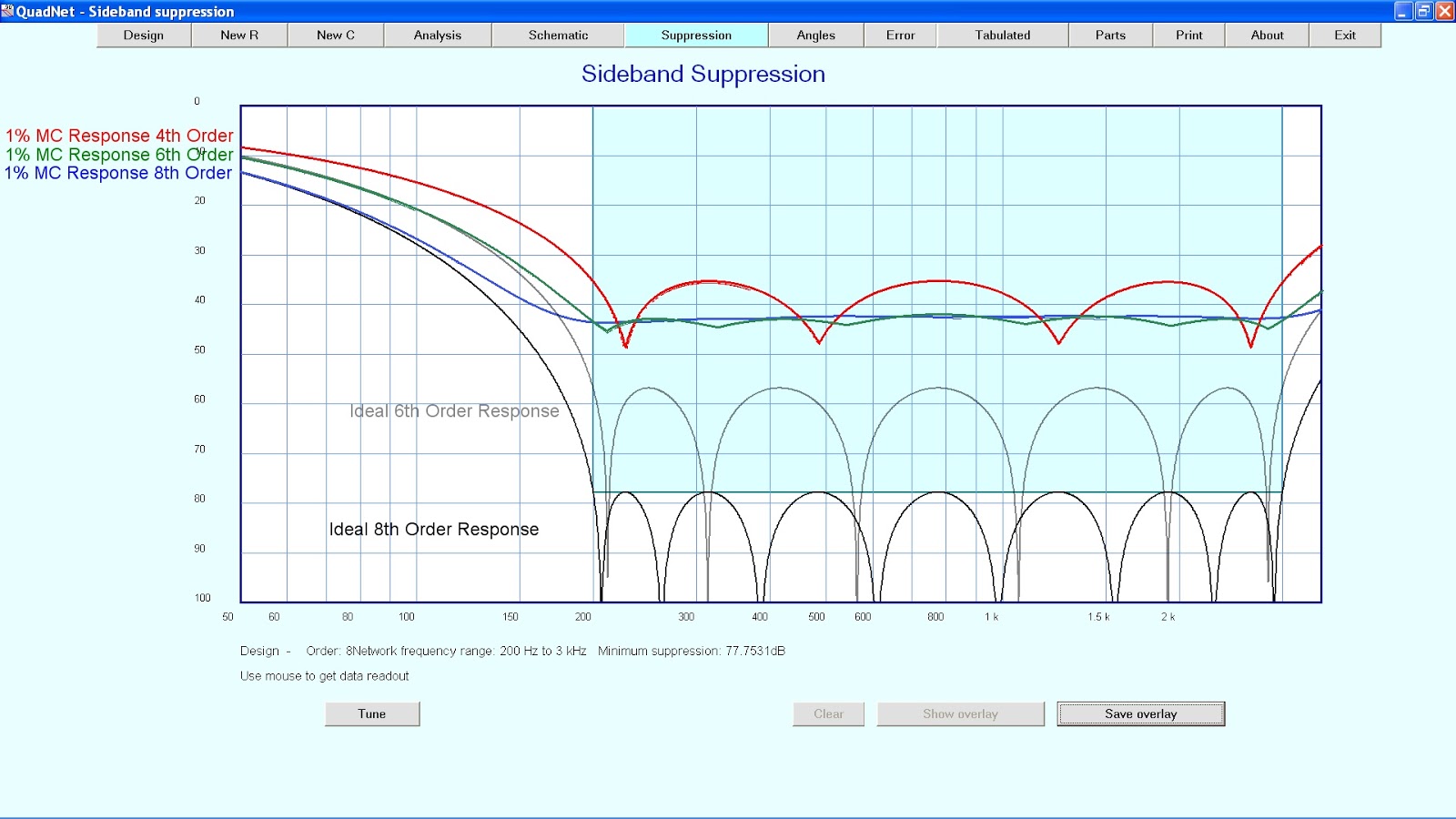
Today I was contemplating how complex does this network need to be. I fired up  Quadnet, from Tonne Software, and examined this issue. It turns out that if you are just going to accept that the best tolerance you can achieve is 1% then there is little point in using an 8th order filter. The monte carlo shows that the worst result for the 6th and 8th order filters is largely identical.


While 43db or so of sideband suoppression is a good starting point if you have the worst case outcome, the improvement with tighter tolerances is considerable. You might get closer to 55db of sideband suppression with a 6th order filter, or 77db with an 8th order filter.

I like the way this software allows you to measure a capacitor and then use that value to determine the required resistor values. With a bunch of measured capacitors you could tweak the placement of these and the resulting resistor values to get the best result.

More thought is needed before I decide on a course of action. However, it does illustrate the point that garbage in garbage out applies. Since I strive to get the best out of anything I do I will have to think about calibrating my digital LC meter now.

Regards
Richard VK6TT